
 |
||
 |
|
|

 |
 |
 |
 |
 |
 |
 |
 |
The Yale Alumni Magazine is owned and operated by Yale Alumni Publications, Inc., a nonprofit corporation independent of Yale University. The content of the magazine and its website is the responsibility of the editors and does not necessarily reflect the views of Yale or its officers. |
Comment on this article Trustees Move Toward Approval of Two New Colleges Yale is one step closer to building its 13th and 14th residential colleges. At its February meeting, the Corporation, Yale’s board of trustees, made the latest move in the university’s careful and deliberate progress toward the goal: it requested a construction budget and a budget for the increased operating costs that two new colleges—and a 12 percent expansion of the undergraduate body—would bring. The Corporation did not actually approve the project. But many officials close to central administration say privately that the outcome is a foregone conclusion. Also at the February meeting, the Corporation asked the development office to prepare a fund-raising plan for the project. President Rick Levin, who has endorsed expansion, says he will seek final approval at the Corporation’s June meeting. Shortly after the Corporation met, Yale released the findings of a study group charged to investigate the ramifications of building new colleges. The report neither endorses nor rejects the idea of expansion; instead, in just over 100 pages, it outlines what would be needed to make the plan work. Adding more undergraduates, the group said, will require adding seminars and courses (and thus teachers) in some departments—particularly those that are already oversubscribed, such as chemistry, English, economics, and political science. The group also recommends livening up Prospect Street to make the new colleges seem less remote, improving shuttle service, and developing a “robust security plan.” President Levin had initially assumed that the new colleges would house their own freshmen (as Timothy Dwight and Silliman colleges do) but many people the study group spoke to believe the new freshmen should live on Old Campus. The report recommends convening a task force to sort out that question. Green Roofs and Grad Students: Readers Respond Yale Alumni Magazine readers responded enthusiastically to our call in the March/April issue for ideas and opinions about the new colleges. Some proposed alternatives to the Prospect Street site. Emmitt Dove '72 of Branford, Connecticut, was particularly creative: “The site … could be used to build new facilities for the Graduate School and the Law School, with the current facilities for those schools then being renovated into new residential colleges.” Lloyd Etheredge '74PhD of Bethesda, Maryland, suggested ways to improve graduate student life, including “at least one new graduate residence/dining hall. It might especially benefit foreign graduate students.” As for design, Anthony Hayden '50 of Old Greenwich, Connecticut, sees green: “Why not try gardens on the new buildings cared for by the botanic part of the science curriculum? Set an example! Cities with a lot of green roofs could improve the air downwind for healthier breathing.” The key for Horace McCowan '49JD of Richmond, Virginia, is the courtyard: “I have had the possibly unique experience of living on the Lawn at the University of Virginia, on the Old Campus at Yale, in the Yale Law School quadrangle, and in the Queens' College Cambridge quadrangle. The common denominator of all of these beautiful academic settings was the quadrangle.” Two Ezra Stiles College alumni who wrote in shared a certain note of distress. Deborah Deliyannis '88 of Bloomington, Indiana, says Stiles and Morse colleges “were an experiment that failed, and students have had to suffer in them ever since. Please don’t inflict that upon new generations of Yale students! I shudder to think what might result from whatever the current architectural fads are.”
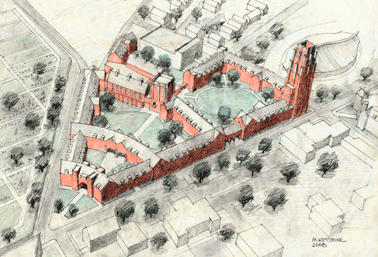
Michael Wetstone '87, '91MArch, an architect in New York, says Stiles “had a strange coldness, a repetitive sameness to everything, a disappointing lack of detail and craft.” He submitted the drawing above as a recommendation for recreating, on the new site, the features he admires in the older colleges: “a variety of sizes of courtyards, towers, large and small elements, archways leading off to other spaces, an organic asymmetry, with an unexpected surprise around each corner. … An inclusive sensibility is required—more details, more materials, more variety —where Saarinen tried to do the opposite.”
|

Related Your dream college here (Mar/Apr 2008) Name those colleges! Readers' suggestions, and ours Yale moves toward college expansion (Feb. 28) Students wary of college expansion (Jan/Feb 2008) President Levin on expansion (Mar/Apr 2007) Should Yale College get bigger? (Jan/Feb 2007) |
|
|
|
|
|
|
|
|
|
||
|
||
©1992–2012, Yale Alumni Publications, Inc. All rights reserved. Yale Alumni Magazine, P.O. Box 1905, New Haven, CT 06509-1905, USA. yam@yale.edu |
||