
 |
||
 |
|
|

 |
 |
 |
 |
 |
 |
 |
 |
The Yale Alumni Magazine is owned and operated by Yale Alumni Publications, Inc., a nonprofit corporation independent of Yale University. The content of the magazine and its website is the responsibility of the editors and does not necessarily reflect the views of Yale or its officers. |
|
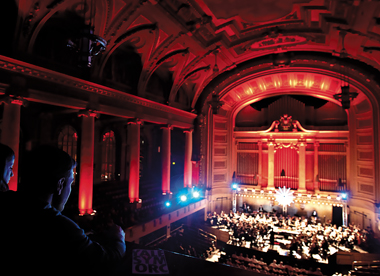
The Russian composer Alexander Scriabin (1872–1915) had a mystical approach to his craft and very big ambitions. His goal for Prometheus, for orchestra and colored lights (shown here in performance by the Yale Symphony Orchestra): properly executed, the piece should bring about spiritual transcendence and “the end of the universe as we know it,” says Anna Gawboy ’10PhD, who wrote her dissertation on his work.
Proper
execution was a problem in 1910, when Scriabin wrote Prometheus. Dissatisfied with the
technology available for the light effects he wanted, such as fireworks and
tongues of flame, he chose to premiere the work in the dark. There have been
attempts over the years to restage it in accordance with his wishes. But Gawboy
reexamined the original manuscript, and she and Justin Townsend, a lighting
design professor at Northeastern, collaborated on a more authentic staging for
the February 13 YSO concert—including lights throughout the hall and a smaller
LED light show onstage, performed by a musician at a keyboard. The effect was
dramatic. But it was not, Gawboy cautions, definitive: “A truly definitive
performance of this work would end the world.” |

|
|
|
|
|
|
|
|
|
||
|
||
©1992–2012, Yale Alumni Publications, Inc. All rights reserved. Yale Alumni Magazine, P.O. Box 1905, New Haven, CT 06509-1905, USA. yam@yale.edu |
||