
 |
||
 |
|
|

 |
 |
 |
 |
 |
 |
 |
 |
The Yale Alumni Magazine is owned and operated by Yale Alumni Publications, Inc., a nonprofit corporation independent of Yale University. The content of the magazine and its website is the responsibility of the editors and does not necessarily reflect the views of Yale or its officers. |
|
The newly announced policy banning faculty from having amorous relationships with any undergraduate student is poorly drafted (“University Bans Faculty-Student Sex,” March/April). Because it is based on a stereotype of all undergrads as 19 years old and all professors as 45, it omits consideration of some easily foreseeable circumstances. What about relations (including marriage) that already exist when a prospective faculty member or student wishes to come to Yale? What about students returning to Yale in retirement to complete their educations as a matter of pride and enrichment? This rule seems to bar faculty spouses from taking courses. What ever happened to Plato’s Symposium? Are we throwing that out the window? Though I appreciated the article by Carole Bass ’83, ’97MSL, I have a quibble with Deputy Provost Charles Long, who cites an anonymous faculty member saying, “Parents don’t send their kids to Yale to sleep with their professors.” My parents didn’t “send” me anywhere. I was 17 when I applied. I was 33 when I finished repaying loans. My parents had little to do with the process, fiscally or otherwise. And I know from countless chats with classmates through the years that my self-driven experience is quite common. So here’s my message to Long and/or the “reliable member of the faculty” he cites: watch your words. Your undergrads are not hapless dependents passively “sent” to New Haven by their parents. Not in my experience, anyway.
Stories Behind the Bookplates I read your article on bookplates with great interest (“This Is My Book,” March/April), and I enclose my bookplate, which was drawn by John F. Almquist ’56 (since deceased, alas) when we were classmates in New Haven. Of course you may keep it and add it to your great collection. I’ve always enjoyed books and am on two boards: Heyday Books in Berkeley, California—35 years and going strong, printing some 20 books a year, all in California—and the University of California Press, also in Berkeley. A great article! Much appreciated.
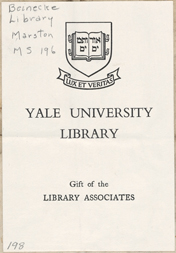
I was fascinated by Alex Beam ’75’s article on bookplates in the Yale Alumni Magazine, especially by the two-page spread showing three bookplates for a book now in the Beinecke Library. The “ordinary” Yale University Library bookplate (shown with two “special” plates) was probably not printed by me, but I did produce many similar bookplates as a freshman bursary student in 1952–53, under the direction of Mrs. Eleanor D. Wheeler in Sterling Memorial Library. I was sole operator of the Sterling library letterpress shop, next to the bookbindery. My qualification for that bursary appointment was a six-year printer’s apprenticeship at the Indiana South Whitley Tribune. There are indeed many stories behind the bookplates.
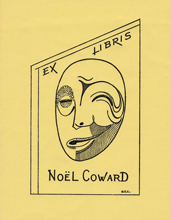
Thanks to the readers who sent us their personal bookplates—and favorite items from their personal collections. The bookplate at left comes from Sylvan M. Barnet Jr. ’40. It was made when he was a student at Yale, and features the clerk from the Canterbury Tales. The one at the right was sent to us by Geoffrey A. Johnson ’55MFA. It is the bookplate of the playwright Noël Coward.—Eds.
The First Lady of Math? I was pleased to read that President Richard Levin ’74PhD chose to share the story of Grace Murray Hopper ’34PhD with the incoming Yale College Class of 2013 (“A Yale Pioneer,” November/December 2009). But I was surprised to learn that Hopper “was the first woman to earn a Yale PhD in mathematics.” In fact, the first woman to earn a Yale PhD in mathematics was Charlotte Cynthia Barnum (1860–1934). Like Hopper, Barnum earned her undergraduate degree in mathematics from Vassar (in 1881). Unable to gain admission to doctoral study at Johns Hopkins, Barnum came to Yale in 1892—the first year women were admitted to the graduate school—and earned her PhD in mathematics in 1895. Including Barnum, a total of ten women earned Yale PhDs in mathematics prior to 1934. Grace Hopper was a pioneer in many respects, but she was definitely not the first woman to earn a Yale PhD in mathematics. President Levin responds:
The Missing Activists I did not know what to make of your article on Yale’s participation in a statement of principles to make available the fruits of life-saving health research in poor countries (“Balancing Profit and Principle,” March/April). Is the new policy statement strong? Does it go far enough? Will it have much of an effect? To help me judge these things, I would have liked to have heard from the activists who have been campaigning to convince university administrators to make essential medicine available to all. It would have been quite convenient for your reporter to have asked these activists their opinion, since the movement got its start at Yale and still counts Yalies among its key leaders. I, for one, would like to hear these Yalie experts’ opinions about Yale’s new commitments.
Why Did Yale Choose Me? I founded and then for 20 years directed a two-way bilingual Montessori school for children from early childhood through middle school, and I always had our older children conduct tours with prospective families, the media, and other visitors. This is exactly the strategy that Yale pursues in its student-led campus tours and now with its admissions video, That’s Why I Chose Yale (“Singing Yale’s Praises. Literally,” March/April). Yes, the buildings are gorgeous, the grass an impeccable green; but there is nothing more convincing than the competence, confidence, and buoyant good humor of those students, their high hopes, their dreams. I’ve volunteered to interview Yale College applicants for 30 years now, and I sometimes wonder, “Why did Yale choose me?”—or any of us, for that matter. In my years at Yale (both college and grad school) I seldom had any reason to suspect that anything wondrous lay anywhere outside of the realm of the possible, and “Why I Chose Yale” definitely embodies that feeling. But those of us on the far side of our lives in New Haven may, upon reflection, discover a broader range of issues and feelings—that is, once we’ve picked ourselves up off the floor, astonished as we must be by this thoroughly astonishing video.
The Yale Density Challenge Regarding your request for Yalie-dense locales (Letters, March/April): West Passage, The Moorings, Vero Beach, Florida, has nine units. Four have Elis as head of the house: Spence Montgomery ’37, Ray Eusden ’45W, Joe Paquette ’56, and yours truly. We are not a town, but we are 44 percent. Beat it? Our challenge to locate the most Yalie-dense spots on earth continues. If you believe your hometown can outdo Woodbridge, Connecticut (4,400 Elis/100,000 residents)—or at least beat Princeton, New Jersey (3,182/100,000)—please send us a letter with your location and population statistics.—Eds.
Levin is Worth It I must take great exception to the commentary of Daniel Broderick ’79JD regarding President Levin’s compensation (Letters, March/April). I take great umbrage (I love that word) at his assertion that our president is overcompensated and his salary and benefits are “obscene.” President Levin works 24 hours daily promoting the university, traveling on its behalf, speaking at university-sponsored events, and even attending the Yale-Harvard football game. His remuneration is minuscule compared with what major college football and basketball coaches receive. So don’t talk to me about Dartmouth, Harvard, and Stanford: small change as far as I am concerned. Mr. Levin deserves everything he receives.
A Libertarian’s Lament Let me get this straight. President Levin has to sort of apologize, and at a minimum “explain” that he has hired a free-market guy to run our business school (“SOM Lands a Leading B-School Dean,” March/April)? We libertarians have far to go.
Headlines and Editors Fred Shapiro looked good in “Yankees Yes, Hot Dog No” (March/April) right up to the last paragraph, where he hit a snag. He cites Barry Popik as source for the story that the sports editor of the Evening Journal in 1904, Harry Beecher ’88, coined the nickname “Yankees.” Popik, he says, credits Beecher because the Eli was sports editor at the Journal when the headline first using the term appeared. It’s not likely that Beecher coined the phrase if it appeared in a headline. When I was a reporter (Minneapolis Tribune, 1951), and still today I think, headlines were written at the copy desk by copy editors—as slouched a bunch of underpaid ink-stained wretches as you’d ever want to meet. They did it all day and all night, eight hours a shift, green eye visors pulled low. After editing and marking up the reporters’ pieces, they then flew dizzily on such foreshortened flights of creative literary fancy as led to “Yankees”—developing over time into the art form that we see flowering daily in the New York Daily News and Post front pages, for instance. Never would an imperious sports editor, especially back in 1904, stoop to write a headline. That was for the minions to do. Hope you take this with mustard and relish, Fred and Barry.
Yale’s Polo Champions In “Polo Ponies Kicked Off Campus” (March/April), recounting Yale polo’s history since 1920, you fail to mention the fact that the polo team of 1957, captained by Michael Poutiatine ’57 (now, alas, deceased), won the national polo championship. That fact, along with others notching ’57’s place as the class holding the most Ivy championships on record, is now suitably inscribed at the Class of 1957 portal at the Yale Bowl.
The Anthropology of Booze The two years I spent at Yale College in the early 1970s were clearly insufficient to help me bridge the cultural and class divides that separated me from many of my classmates. As evidence, I cite the surprising statistic (“Alumni by the Numbers,” March/April) that nearly 30 percent of Yale alumni buy distilled liquor by the case. Although this statistic may be unsurprising to many Ivy League graduates, it strikes me as extraordinary. Although I enjoy the occasional sip of whisky, I have never had the occasion, during my 54 years on this planet, to purchase a case of hard stuff, nor have I seen any signs that any of my acquaintances have ever done so. Future anthropologists should use this question as a class marker. I believe that further research will show that a positive answer to this question correlates strongly with high incomes and alcoholism.
Of Screwing and Scrambling I understand from “Quack Means Quack” (March/April) that ducks are well equipped for screwing—and that the term is more descriptive in ducks than people. However, I have lost my appetite for balut and century eggs.
A More Historic Football Venue? I must take some exception with the assertion by Christopher Getman ’64 in his letter to the editor in your March/April issue, where he writes that the Yale Bowl is “the most historic football venue in the country.” First, I must quickly explain that I spent two years at Yale, then transferred to the Wharton School at Penn, whence I graduated. My exception with Mr. Getman is that Franklin Field at Penn was built in 1895 (the Bowl: 1914). Franklin Field is deemed by the NCAA as the oldest stadium still operating for football games. Among other firsts, it had the first scoreboard, the first two-tiered stadium, the first radio broadcast of a football game, and the first telecast. Furthermore, I clearly remember as a freshman in New Haven the miserable trip to the Bowl in bad weather, sitting there exposed to the elements, and cadging rides back to campus. (Freshmen were not allowed cars in 1951.) At Penn, the stadium was a 15-minute stroll from our fraternity house. We sat in seats under the overhang of the upper deck; thus we were never rained upon. The stadium has within it all the amenities—rest rooms, food concessions, and of course the team’s facilities. Since I attend every Penn football game, I see all the Ivy League “stadiums.” The only real stadiums are at Penn, Princeton, Yale, and Harvard. The other four schools have what I call “grandstands” on either side of their fields, but not stadiums. But Penn’s is the most historic, the closest to campus, by far the most comfortable and sheltered.
Correction A caption for two photos in “The Wunderkind” (March/April) failed to identify one of the people pictured as a Yale alumnus. The actor Gideon Banner, who appeared in a 2008 production of The Four of Us by Itamar Moses ’99, graduated from Yale College in 1999. |


|
|
|
|
|
|
|
|
|
||
|
||
©1992–2012, Yale Alumni Publications, Inc. All rights reserved. Yale Alumni Magazine, P.O. Box 1905, New Haven, CT 06509-1905, USA. yam@yale.edu |
||