
 |
||
 |
|
|

 |
 |
 |
 |
 |
 |
 |
 |
The Yale Alumni Magazine is owned and operated by Yale Alumni Publications, Inc., a nonprofit corporation independent of Yale University. The content of the magazine and its website is the responsibility of the editors and does not necessarily reflect the views of Yale or its officers. |
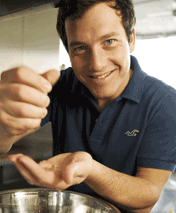
As an undergraduate, Dave Lieberman ’03 developed and starred in a cooking show broadcast on New Haven’s public-access cable channel. Since then he has taken his regular-guy approach to the Food Network. He recently finished his second cookbook, Dave’s Dinners: A Fresh Approach to Home-Cooked Meals. Y: I watched your show this weekend and made your chocolate and walnut holiday cookies. They were pretty good. You're one of the only cooking-show chefs I’ve seen who actually measures flour right out of the container on camera, instead of having that typical array of ingredient-filled bowls. L: Right. We try and make it look and feel like we’re actually cooking. Y: What got you started cooking? L: Really early on, growing up, my dad was the cook in the house, and I would kind of hang out and cook with him. My dad’s cuisine is utilitarian. He was putting an emphasis on healthy foods and good ingredients, but it was pretty basic flavors and minimal preparation involved. That’s maybe where I got my streamlined approach. He definitely did things in a streamlined, efficient way. Y: You’ve said that you'd like to get into the political aspects of food. What kinds of issues do you think you're in the best position to address? L: I want to address the way Americans think about food, our disconnect with food. I also want to make sense for the common person of the issues of organic and responsibly raised products—and interpret this movement toward a green sensibility. Y: A lot of organic food marketing in this country is pitched toward an elite class of consumers. L: Exactly. People perceive that making the right choices is only the domain of people who have the luxury of time and money. Y: To judge from various blogs and Internet discussion groups, you’ve got quite a following nowadays. And their appetite for dissecting everything from the fit of your jeans to your sexual orientation seems endless. How does it feel to have fans debating things like what kind of shirt collar flatters you best? L: Back in the beginning, I would look at that stuff. But then I stopped. I know there are websites out there that dissect people on the Food Network, and I just don’t pay attention. Y: I noticed that on your website your bio sketch doesn’t mention Yale at all. How come? L: I thought it was on my bio. It’s not there at all? Well, sometimes I gloss over going to Yale because I don’t want to alienate people or seem like I’m coming from a different place than they are. I’m certainly proud to have gone to Yale—but for people who don’t necessarily understand Yale, or have preconceptions about it, I don’t want to let that come between us. Y: Do you miss anything about your days on public access in New Haven? L: You know, I do. I miss working
with friends. It felt a little more like a team, and we had a common purpose.
Now you get good people on a job, but they’re there mostly to earn a living, at
the end of the day. And that was something different about working as friends
and students—we were doing it out of passion. |

|
|
|
|
|
|
|
|
|
||
|
||
©1992–2012, Yale Alumni Publications, Inc. All rights reserved. Yale Alumni Magazine, P.O. Box 1905, New Haven, CT 06509-1905, USA. yam@yale.edu |
||