
 |
||
 |
|
|

 |
 |
 |
 |
 |
 |
 |
 |
The Yale Alumni Magazine is owned and operated by Yale Alumni Publications, Inc., a nonprofit corporation independent of Yale University. The content of the magazine and its website is the responsibility of the editors and does not necessarily reflect the views of Yale or its officers. |
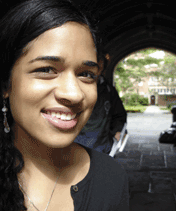
MacArthur Winner Comes Out of the Forest For Lisa Curran, director of the environment school’s Tropical Resources Institute, the news—arriving via cell phone as she stood outside a seminar room on September 13—set her legs shaking and eyes watering before she had to “walk back in, sit with my colleagues, and try to keep my cool.” The call was from the John D. and Catherine T. MacArthur Foundation, telling her she had won one of the five-year $500,000 fellowships often called “genius grants.” Curran, 45, was chosen because of her work on deforestation and its devastating effects. “In hindsight, my research is the kind of thing they like to fund, because it’s outside the box,” Curran says of the grant. “But did I even think I’d receive something like this? No way. I’ve nominated people whose research I thought was more deserving.” After graduating from Harvard in 1984, Curran traveled to Borneo, where she lived in Indonesian logging camps for eight years while gathering empirical evidence on the destruction of forests on the island. She came back to the United States to complete a doctorate at Princeton and a postdoctoral fellowship at Harvard, then joined the Yale faculty in 2001. Until recently, Curran has spent almost half of each year in the field. In an effort to counter illegal logging, she brings scientific findings on Borneo’s ecology to the sociological, political, and economic players with interests in the island's forests. Curran has also been a key player in the establishment of several national parks in Indonesia. Curran and her team have received death threats from industry insiders, dodged gunmen, and evaded kidnappers. But she says the “fight for change” keeps her going. “We’ve documented things about consumption and its effect on the ecosystem that have changed forestry policies and trade agreements with U.S. companies,” Curran says. Right now, the professor of tropical ecology is “taking her first breather in a long time,” but later in November she will return to Borneo, where she will use a portion of her award to aid in the education and training of her female colleagues in Indonesia.
Stepping down Rev. Frederick J. Streets will leave his position as university chaplain next spring after 15 years in the post. Streets, who has been credited with incorporating a diversity of faiths into Yale’s religious ministry, has also served as an adjunct professor at the Divinity School for 19 years. Streets says, “It’s been an honor and a pleasure to have served for the past 15 years. It’s an exciting and robust time for the work of the chaplain’s office, and I hope that I have made a contribution to the Yale community and the relationship between Yale and New Haven.” The search for a new chaplain is under way.
Appointed Fred R. Volkmar has been named the director of the medical school's Child Study Center, a research and treatment facility for children’s mental health. Volkmar, the Irving B. Harris Professor of Psychiatry, Pediatrics, and Psychology, is noted for his research into the mechanics of autism and strategies for early intervention with autistic children. A member of the medical school faculty for 24 years, Volkmar has been appointed to a three-year term, succeeding Alan E. Kazdin.
Honored
Glamour magazine has named Maya Uma Shankar '07 one of the top ten college women in its annual nationwide competition to find “the next Hillary, Condoleezza, and Oprah.” Shankar is tagged as “The Scientist”—she plans to go to graduate school in cognitive science—but she isn’t easy to pigeonhole. She has coordinated the Yale branch of United Students against Sweatshops, founded and edited a human rights magazine, and performed on violin with Itzhak Perlman at Carnegie Hall’s Weill Recital Hall. The Graduate School of Arts and Sciences awarded its Wilbur Lucius Cross Medal to five alumni. They are Eva Brann '56PhD, a classics scholar and the first female dean at St. John’s College in Annapolis, Maryland; Richard Brodhead '68, '72PhD, president of Duke University, scholar of American literature, and former dean of Yale College; Mimi G. Gates '81PhD, curator of the Seattle Art Museum and former director of the Yale Art Gallery; Lewis E. Kay '88PhD, professor of medical genetics, biochemistry, and chemistry at the University of Toronto and an expert in nuclear magnetic resonance; and Richard A. Young '79PhD, professor of biology at MIT, and a leading researcher in gene transcription. (For more, see School Notes.)
|

|
|
|
|
|
|
|
|
|
||
|
||
©1992–2012, Yale Alumni Publications, Inc. All rights reserved. Yale Alumni Magazine, P.O. Box 1905, New Haven, CT 06509-1905, USA. yam@yale.edu |
||