
 |
||
 |
|
|

 |
 |
 |
 |
 |
 |
 |
 |
The Yale Alumni Magazine is owned and operated by Yale Alumni Publications, Inc., a nonprofit corporation independent of Yale University. The content of the magazine and its website is the responsibility of the editors and does not necessarily reflect the views of Yale or its officers. |
|
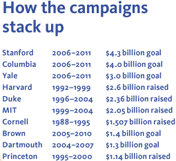
Beinecke Plaza was aglow in blue light on the crisp evening of September 30 as the university formally launched Yale Tomorrow, its five-year-long $3 billion fundraising campaign. Invitees had already spent the day listening to faculty, students, and noted alumni, such as historian David McCullough '55 and actor Sam Waterston '62, describe Yale’s strengths. At the outdoor reception, the mood was upbeat. The transformation of the Beinecke was an apt metaphor, said President Richard C. Levin in remarks at dinner in Commons: the fundraising initiative is designed to help transform what was “once a tiny college for the Connecticut colony into a truly global institution, serving not only America but the world.” President Levin said that the “quiet phase” of the campaign had already collected $1.3 billion in donations. He told the audience that while funds will be directed toward every aspect of the university, there are four areas of special concern: the college, the arts, the sciences, and the expansion of Yale’s reach in the world.
Inge T. Reichenbach, vice president for development, says one of the college’s primary needs is increasing financial aid. In the arts area, funds will be directed toward improvements to facilities and increased support for arts students. The sciences and the medical school are seeking support for new and renovated laboratories, as well as to nurture innovative basic and clinical research programs. Finally, Yale’s globalization priorities include endowed professorships in international studies; support for such endeavors as the World Fellows Program and educational outreach efforts for global leaders; and financial aid for Yale students who want to study abroad and for international students who want to come here. The campaign launch took place just a day after Columbia announced its own $4 billion initiative. Other universities have since announced even larger goals. Had Yale aimed too low? “We carefully assessed our needs, and $3 billion was the number that will allow us to accomplish the goals that President Levin outlined in our campaign statement,” says Reichenbach. “Campaigns are designed to help an institution fulfill its potential and aspirations—we don’t see them as a competitive sport.”
Yale in Cyberspace Aside from those at the drama school, few faculty members arrive at Yale expecting to face the world of lights, camera, and action. But on September 19, President Richard Levin announced that Yale will begin offering video lectures over the Internet. The university will debut seven courses next fall, including “Introduction to the Old Testament,”"Fundamentals of Physics,” and “Introduction to Political Philosophy."The courses will not be interactive—there will be no grading or academic credit—but every lecture, as well as selected course materials such as syllabi, will be available to the world at large, free of charge. Many other universities have ventured onto the Internet. Rice offers course materials for free, and MIT has put detailed material online for more than 1,400 courses, including 21 video classes. But Yale will be the first to offer complete courses on the Web. Diana E. E. Kleiner, Dunham Professor of the History of Art and Classics, who heads the project, says that while there’s no substitute for actual human interaction, Yale intends for all those who sign up to receive the benefits of auditing a Yale class. Yale isn’t new to Web instruction. In 2000, with Stanford and Oxford, it launched the Alliance for Lifelong Learning (AllLearn), a for-profit venture. AllLearn offered 110 online courses (graded, but not for credit) to 10,000 students in 70 countries. AllLearn did not succeed financially, and it folded earlier this year. Kleiner wants the new online classes to add to Yale students' learning—not give them a way to skip class. However, most of the professors don’t seem worried. “I guess if that becomes a problem, I’ll stop teaching the class,” says Steven Smith, Alfred Cowles Professor of Political Science. “I don’t think watching some lectures on a computer really substitutes for going to class.” Filming has already begun on three of the courses that will go up. Smith’s is one of them. His advice for the camera-shy: “The trick is simply not to think about the filming. From my own point of view, it will be successful if I don’t embarrass myself too badly.”
Public Health Program Attracts Undergrads AIDS in Africa, the threat of bioterrorism, epidemic obesity: public health crises have global implications, yet their effects are invisible to most college-age Americans. Nonetheless, student interest in public health-related issues has exploded, and course offerings in the field regularly attract hundreds of students at colleges around the country. At Yale, the undergraduate demand has led to the creation of a joint undergraduate-master’s degree program between the college and the School of Public Health. Launched this fall, the Select Program in Public Health will enable ten students annually to begin work on a master of public health (MPH) degree before they graduate from Yale College. After graduation, they will enroll full-time in the School of Public Health for an additional year, during which they finish the remaining curriculum and a master’s thesis. (An MPH normally takes two years.) The undergraduates must complete a standard major, along with courses in public health and statistics; they will also complete a public health internship during the summer following college graduation. For its first year, the program made a one-time exception and enrolled 16 total students from the junior and senior classes. In future, only ten students will enter the program, starting in their junior year. Acting director Jeannette R. Ickovics says the program had many more applicants than spaces. “It was quite competitive,”she says. “And we’re expecting far more applicants in the coming year."Ickovics credits burgeoning student interest in public health—more undergraduates now take courses in the School of Public Health than in any other professional school—and the innovative nature of the program for its popularity. “It provides an opportunity for broader thinking, earlier,”she says. According to Karen Helsing, director of education and research for the Association of Schools of Public Health, Yale and 22 other graduate schools of public health (out of 38 in the nation) now teach undergraduates. “For undergraduates, these are highly engaging and relevant programs that will conduce to the good of the world,”says Helsing. Robert Nelb '08, '09MPH, a student in the Select Program, agrees. “It doesn’t surprise me that so many students have taken up the call of public health,” says Nelb. “These are some of the biggest problems facing our generation."As evidence of the growing undergraduate interest, he points to two new student journals and a popular speaker series. Yale College dean Peter Salovey says that a set of courses in health studies is beginning to coalesce in the college. “We hope to collect enough courses ultimately so that they might be organized into some kind of program or even an undergraduate major.”
New Help for Sexual Assault Victims Undergraduates who are sexually assaulted or harassed now have a central place to turn, thanks to a new Yale College initiative. After two years of criticism of how it handles sex offenses, the college this fall launched the Sexual Harassment and Assault Resources and Education (SHARE) Center. Currently housed at Yale University Health Services and headed by clinical psychologist Carole Goldberg, the center offers a 24-hour hotline, counseling, and support for undergraduates who have experienced sexual trespass. Establishing Goldberg’s position addresses one of two major recommendations in a report to Yale College dean Peter Salovey ’86PhD last spring. The university has also taken steps to implement the second recommendation: that it give a truer picture of sexual assault by internally reporting all complaints, formal or informal, on- or off-campus. Salovey requested the report from the Yale College Sexual Harassment Grievance Board last year in the wake of criticisms—first in a New York magazine article by Naomi Wolf ’84, and then in a Yale Alumni Magazine investigation by Emily Bazelon ’93, ’00JD—that Yale’s handling of sexual assaults tended to discourage victims from coming forward. The board found that while the college has plenty of resources for assault victims, students often don’t know what’s available. Should they call campus police? Talk to the residential college dean or master? Approach friends, clergy, or the harassment grievance board? Any of the above could be fine, the board concluded. “There was a strong advantage in providing a wide variety of entry points for students to use in reporting such a personal trauma as sexual assault,”the report says. At the same time, the board found a need to make the system “somewhat more centralized and transparent"-- in other words, to make it easier for students to figure out where to go and what to do. “Through the center we can help students become aware of various options, encourage them to seek medical attention or legal advice, and support them in their decisions,”says Goldberg. In addition to a coordinator and a hotline, the report recommended a
strong web presence for Yale’s sex-assault prevention and response efforts. “Recognizing
that students instinctively turn to the internet as a source of information,”
it called for “an easily navigated website, which would allow the student to
understand and compare the procedures and options available within the
University."Goldberg expects the website to be operational in November. |



Watch out, Uma! It should come as no surprise that actress Uma Thurman stopped traffic on a recent visit to New Haven. Chapel Street was closed for hours at a time for two days in September while filmmakers shot scenes for Thurman’s next movie, tentatively titled In Bloom. Students and other passersby got a taste of the tedious side of moviemaking as Thurman (or, more often, her stand-in) repeatedly crossed Chapel for a scene in which she is struck by a car. Several scenes for the movie were shot at Yale and in New Haven. |
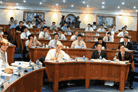
Sincere flattery In 2004 and 2005, Yale hosted summer workshops for officers of China’s top universities to fill them in on how U.S. research universities work (see “Yale and the Next Superpower,” November/December 2004). This past summer, President Richard Levin and Vice President Linda Koch Lorimer attended a similar workshop at Xiamen University, in which the Chinese discussed how they are adapting U.S. ideas. Although it was 12 time zones away from New Haven, something about the experience was strangely familiar: Xiamen officials had built a seminar room nearly identical to Room 127 of the Yale Law School, where the group had met in the previous summers. (Levin is in the front row, in white shirt.) |
Campus Clips Map thief E. Forbes Smiley III was sentenced to five years in prison on state charges and three and a half years on federal charges after admitting he had taken 97 maps from eight collections, including Yale’s Sterling and Beinecke libraries. He will serve the sentences concurrently. The early-admissions program at Yale is being reviewed in the wake of Harvard’s announcement in September—followed quickly by Princeton and the University of Virginia—that it would abolish early admissions. Critics of such programs say they force students to think about college too early and favor wealthier applicants. When Yale changed from a binding early decision plan to a non-binding one in 2002, President Richard C. Levin said he would like to abolish early admissions entirely. Following Harvard’s announcement, Levin questioned whether more changes would actually help. Anti-Semitism is the focus of a new program at the Institution for Social and Policy Studies. The Yale Initiative for Interdisciplinary Study of Anti-Semitism, the first such institution in North America, will be directed by ISPS research affiliate Charles Small. Investment czar David Swensen had another outstanding year, bringing in a 22.9 percent return on Yale’s endowment and increasing its value from $15.2 billion to $18 billion. Income from the endowment now covers about 34 percent of the university’s budget, about twice as much as it did ten years ago. Swensen had to yield bragging rights, however, to MIT—whose endowment return came in at 23 percent, even. Yale is number one in sexual health, according to the makers of Trojans condoms. The company looked at the availability of condoms and information about sexual health at 100 colleges; programs like the biennial Sex Week helped secure Yale’s top rank. |
|
|
|
|
|
|
|
|
|
||
|
||
©1992–2012, Yale Alumni Publications, Inc. All rights reserved. Yale Alumni Magazine, P.O. Box 1905, New Haven, CT 06509-1905, USA. yam@yale.edu |
||